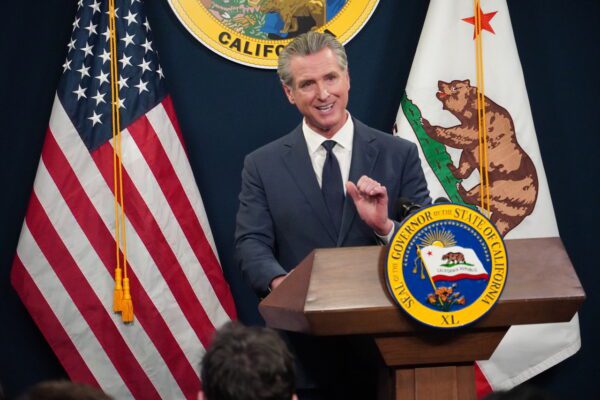
Reparations Rift: Advocates Take Aim at Black Caucus After Gov. Newsom Vetoes Bills
By Antonio Ray Harvey | California Black Media
Over the last two legislative sessions, Gov. Gavin Newsom has signed 11 of 30 reparations-focused bills authored by members of the California Legislative Black Caucus (CLBC).
However, last month, the governor vetoed five key bills among 16 other reparation-focused bills in the CLBC’s “Road to Repair” that CLBC members introduced in the Legislature this year for their colleagues’ consideration.
Advocates — already critical of the bills chosen for the CLBC’s “Road to Repair” package — say they aren’t surprised by the governor’s rejection. They’re calling on caucus members to include their perspectives in drafting future legislation and to engage more directly with community voices in the next session.

Cheryce Cryer, a Los Angeles-based attorney, community activist, and vocal advocate for reparations, told California Black Media (CBM) that she suggests the members talk to their respective communities about future reparations bills to create policies that are equitable, legitimate, and effective.
“I think they need to sit down with the community and say, ‘What is your pleasure’ because they are public servants and they also need to be receptive,” Cryer said. “You cannot put a bill down and say, ‘Come support this.’ I think that’s the wrong strategy.”
Cryer credited CLBC member Sen. Laura Richardson (D Inglewood) for working with the reparations advocacy organization Coalition for a Just and Equitable California (CJEC) to support Senate Bill 515, known as the “Local government: Collection of Demographic Data” bill.
The bill requires cities, counties, and other local governments to use more detailed categories when collecting demographic data about Black or African American employees, starting Jan. 1, 2027.
Although, SB 515 was signed by Newsom, but Richardson’s office did not position the legislation as a reparative justice bill, nor was it a part of the CLBC’s “Road to Repair” package.
The bill made it through the legislative process, partly, because Richardson kept advocates and members of the community in the loop, according to Cryer.
“It wasn’t part of the package but just think of what type of impact that it’s going to have,” Cryer said. “Kudos to Sen. Laura Richardson for sitting down and working with CJEC. That’s how it’s supposed to be done.”
Among the bills, Newsom vetoed were legislation aimed at providing tangible benefits, such as housing and educational assistance, to descendants of enslaved people.
- Assembly Bill (AB) 7, introduced by Assemblymember Isaac Bryan (D-Ladera Heights), sought to allow California colleges and universities to consider descendants of enslaved people. Gov. Newsom vetoed the measure, calling it “unnecessary” and noting that institutions already have the discretion to do so.
- AB 57 by Assemblymember Tina McKinnor (D-Inglewood) proposed a loan program for descendants of formerly enslaved people seeking to buy their first homes.
- AB 62, authored by McKinnor, would have established a program within the Civil Rights Department to investigate and provide restitution for property wrongfully taken through racially motivated eminent domain.
- AB 742, by Assemblymember Sade Elhawary (D-Los Angeles), focused on licensing requirements under the Department of Consumer Affairs for descendants of formerly enslaved people.
- AB 766, authored by Assemblymember Dr. LaShae Sharp-Collins (D-San Diego), would have required state agencies and departments to conduct racial equity analyses for all new state regulations and budgets. The bill was intended to ensure fairness and inclusion, with a focus on Diversity, Equity, Inclusion, and Accessibility (DEIA).
But Brown and other reparations advocates say that over the course of two years, the CLBC may have already missed opportunities to get certain reparations bills over the finish line.
“For next year, 2026, don’t think that CJEC doesn’t have a plan. We are developing and formulating our plan,” Brown said. “We are still in this legislative fight.”